

The uniforms of the Federation are meant to have visual variety, and be liberal with regulations to the benefit of style and fashion. While this is in large part because Wars in Reverie is heavily anime-inspired, and anime characters are known for their distinctive and provocative (lowkey sexualized?) designs, it’s only a part of the reason. Like many other things Wars in Reverie is meant to depict, the Federation’s uniforms are meant to reflect nuance in real life history, and be a vector of further creativity for others to iterate on.
The liberal regulations and varied outfit pieces of Federation uniforms are inspired by the relatively loose uniform standards of 19th-century American uniforms. This is not to say that there were no regulations or standards in the 19th century, but it’s no doubt that U.S. military uniforms have been relentlessly streamlined and standardized in the succeeding 20th and 21st century. Nowadays, all uniforms must all look exactly by the book, and any deviation from the regulations (whether a conscious fashion statement or unconscious incompetency) should be reprimanded or punished.
Contrast this to the early 19th century when the U.S. military was still getting its headway to uniforms: Having two entirely different color pallets (Union Blue and Cadet Gray) due to the shortage of indigo; U.S. officers emulating the styles of upper-class fashion with sashes, coats, cloaks, and hats of widely varying styles and specifications; volunteer soldiers wearing different hats that reflect their homely cultures; Or even volunteer soldiers adorning entirely different uniforms, depending on the generous patron that donated such a uniform to that patron’s personal taste. Granted, this disparate mishmash of uniforms was seldom seen on enlisted men of the Regular Army, but it nevertheless showcases how experimental and fashionable American military uniforms used to be.
In many ways, these loose uniform standards were a direct reflection of the U.S. military through the 19th century, and a reflection of 19th century America as a whole. There were no fast means of communication in the 19th century, and authority was widely decentralized. Everyone, everywhere, was expected to act on their own. This was the time when state governments exercised much broader autonomy due to their disconnection from a far-flung Washington DC. This was the time of state volunteer militias, where standards and quality varied widely between regiment to regiment, not to mention from state to state. This was the time of the “Wild West” and frontier living, where units far west are expected to bear the flag of the United States in the absence of any government to guide, support, or reprimand them. The uniforms of the U.S. military in this time reflected this decentralized nature, where every command, unit, and element was expected to act independently to the whole, and where they adapted to their accordingly and at their own initiative. Whether from the regimental level or on the individual soldier, uniforms were altered or iterated upon; Whether it was the Iron Brigade adorning their famous Black Hats , dragoons and zouaves marching with fashionably distinct uniforms, or a common infantryman wearing undress uniforms with different fabrics due to a shortage of Union blues. America fostered a culture of freedom and liberty, further emboldened by the massive stretches of country that necessitated the common man to act on his own accord — and the American uniforms of the time reflected this.
This was a uniquely American culture, especially in contrast to European ways of battle in the 19th century, where the more densely populated, smaller regions of Europe necessitated closed-order maneuvers and allowed higher officers to exercise more control to the lowest enlisted ranks. This wasn’t seen in America, where European attachés were perplexed at the American soldier’s benefit to formulate his own small-unit tactics . The ragtag American uniforms of the 19th century showcased both the American soldier’s pragmatism to immediately adapt to the field, and the self-identity that defined American culture.
This was something that the United States military had lost as time progressed. Through the 20th century, uniforms throughout the U.S. military were cut down, streamlined, and strictly regulated. This corresponded with the centralization of the U.S. military after the Civil War. The individualism of state volunteer militias was lost — as were their unique uniforms — because of the replacement of the militia system. What succeeded the volunteers was the National Guard, backed by the federal government and featuring all of the strict uniform regulations stipulated by the Regular Army. As the “Wild West” came to a close, and the century turned, uniforms were once again strictly mandated across all units — a mandate better enforced with the federalization of most standing military units. This was the time of the Gilded Age, and of the Great White Fleet, where publicity was not just centered around fashionability, but the power exerted through uniformity. While there were soldiers and marines that fought in their improvised “undress” attire through America’s motley of imperialist conquests, at home, the attitude to uniforms shifted. Long gone were the days of uniforms customized to the individual’s tastes, that best described the locale of the soldier, in came the days of the bravado placed on a formation of similarly dressed soldiery. America’s uniform approach became more European, and such an approach stuck very well as America entered its first European war in WWI.
The U.S. military still had a few bouts of interesting uniform implements, which peaked in WWII: a hodge-podge of different khaki designs used between the army, navy, and marines; Experiments with different jackets and styles, most notably leading to the famous Ike jacket; Missions and environments forging new styles of uniform wear, such as the crusher caps of bomber pilots and radiomen. Like the Civil War and the Wild West, WWII was both a demonstration of American ingenuity on the field, and American fashionability on their wear of uniforms. Unfortunately, immediately after WWII, the American experiment of individual uniforms abruptly died. All of the Army’s interesting uniform pieces from WWII were thrown out with the introduction of the Green Service Uniform. The Army and Marines abandoned the Khaki service uniforms by the mid-20th century. The Navy kept abandoning its interesting uniforms , and constantly threw new uniforms at the wall (NWU Type 1’s , Dress Khakis , 2018 Uniform Prototype ). The Army issued a uniform with a morbidly in-effective camouflage pattern , and expected its soldiers half-way across the world to fight terrorists while wearing the ineffective camouflage that Big Army mandated. The late 20th century was an explosion of American uniform experimentation, but this isn’t any interesting showcase of American ingenuity, individualism, and lower-command initiative. This was top-down decision making, predicated on trend-setting and clout-chasing to make the ✨uniform of the future soldier✨. Or, in the case of the Navy’s Dress Khakis and the Army’s AGSUs , some vane attempt to recall America’s past glories. This isn’t to say that the Dress Khakis or AGSUs are bad, but they would be much more expressive of American values if soldiers could wear them with the situational liberalism as WWII soldiers had (or, if the Navy just committed to the Dress Khakis for any longer than the an average sailor’s marriage). Yes, there are a few examples of individualist uniform pieces returning with the AGSUs — the new ike jackets and airborne garrison caps come to mind. But these pale in comparison to the variability of army service uniforms in WWII. Even at a glance, looking at what uniform pieces these officers are wearing, you can immediately tell who just came from the field (olive trousers), who is the aviator (khaki shirt & trousers), and who is working in garrison (pink trousers). So much individuality and context communicated by different styles of the same uniform. Today, with the constant revolving door of top-down designed uniforms, this is something that no branch of the U.S. military will ever replicate again.
This modern state of American uniforms is what the Federation uniforms are meant to contrast with. The official artworks of Federation uniforms depict varying uniform pieces and different styles of wear, all of which still qualify within the bounds of the “uniform.” The in-universe regulations for Federation uniforms are meant to be looser than real life regulations, so that individual people could express a little personality in their uniform choices if they so chose. Or, if environmental needs demand it, individual people can modify their uniform wear to better adapt to their mission (this applies to service uniforms, “working” service uniforms, or utility uniforms). These liberal regulations, along with the facing colors of a soldier’s unit proudly emblazoned on their uniform, all are meant to showcase the formation-level esprit-de-corps that 19th-century American uniforms once fostered.
The fashionability of Federation uniforms is also an artistic statement. Wars in Reverie, while a depiction of war and politics, is also a celebration of Internet culture, and the youth culture that it fosters. Whether it’s the undeterred creativity that bleeds through the haphazard drawings of a DeviantArt profile, or the teenage angst that fuels the vigor of a self-published anime fanfiction novel, these are the creative inspirations that Wars in Reverie means to subtly emulate. The liberal standards of the Federation uniform are intended to be a tool for the fan-artist. If a person were to ever subscribe to the stories within Reverie, and make their own Original Characters within the universe, they should be able to exercise their creativity to make a unique soldierly OC. But the uniform of such an OC should still be beholden to the image of the uniform — the uniform must still look proper, it still must look soldierly, and it still must maintain the elements that make the uniform serviceable: proper rank placement, regimental colors , neatly groomed fabrics, and the like. Wars in Reverie is meant to depict the contrast between child-like creativity and mature melancholy. Despite the fantastical nature of your character or the fashinability of the uniform they wear, what they wear must still be a military uniform.
This is the thin line that the Federation’s uniforms occupy. It should look colorful, but soldierly. It should look fashionable, but soldierly. It should show creativity, but also show conformity. It should not matter if the soldier is an anime catgirl, a furry goat, a dark elf, or anything else — so long as she is dressed to the occasion.
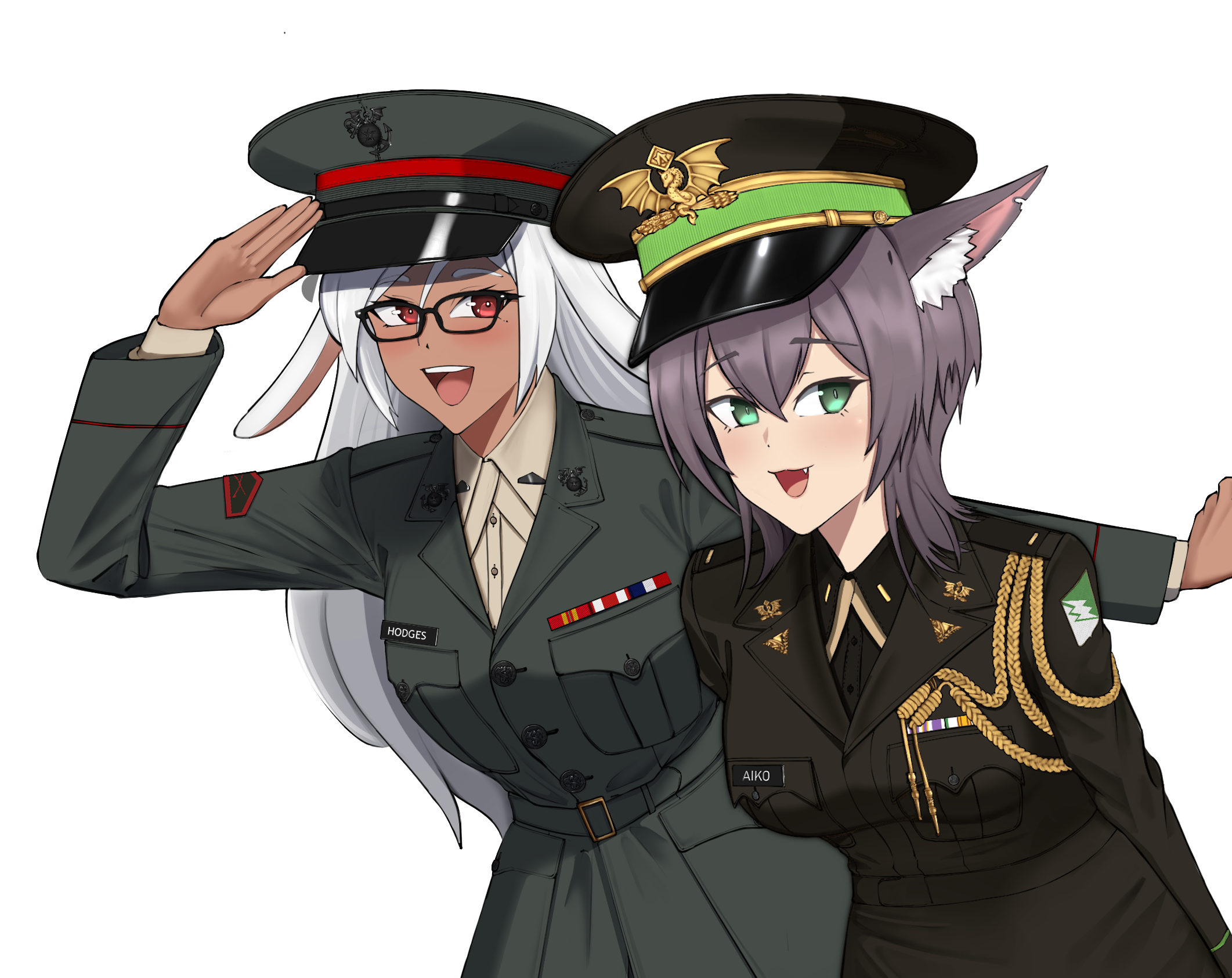
If she looks like a soldier, and if she dresses like a soldier, then…